
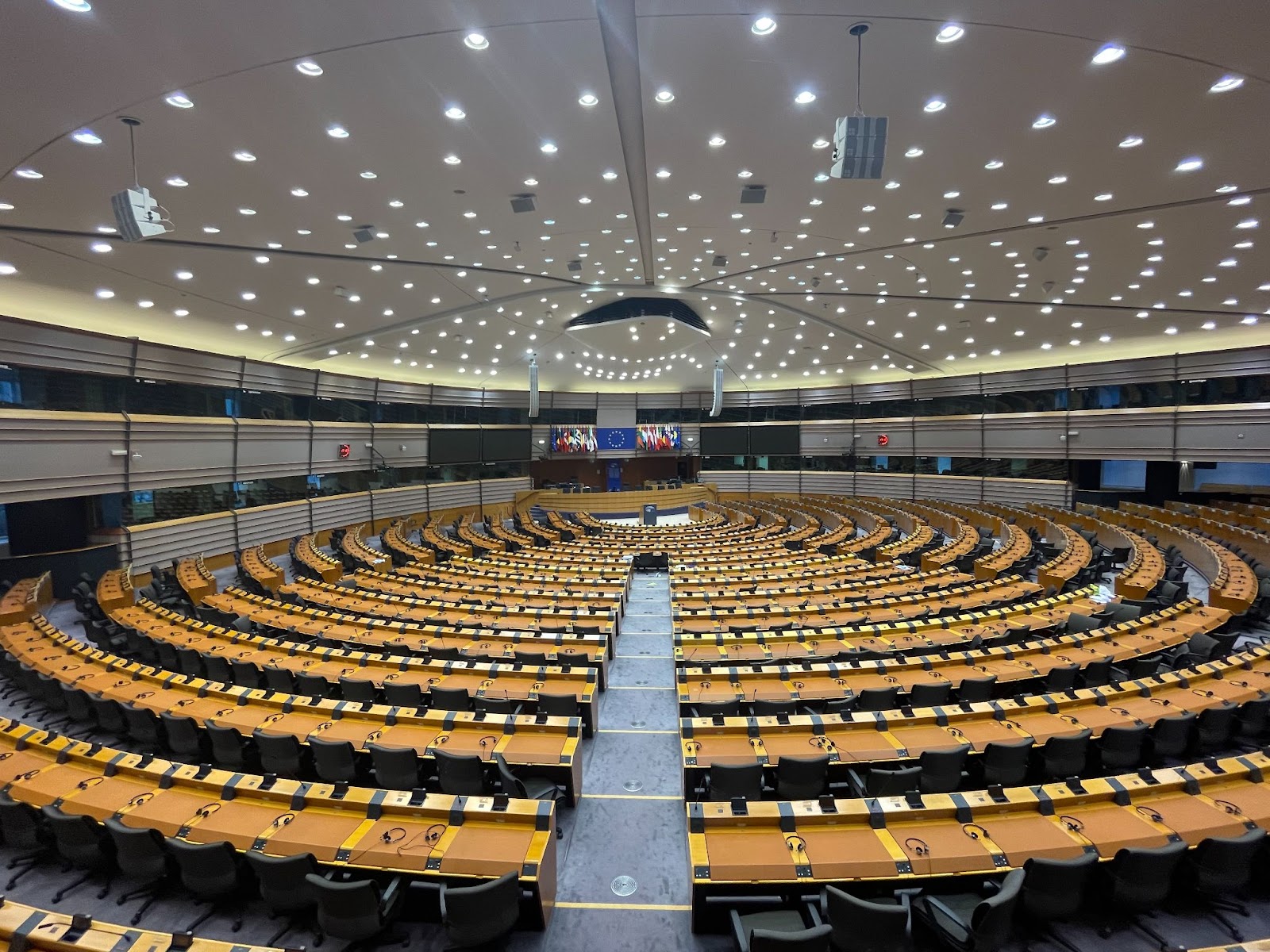
The European Commission, the European Parliament and the Council of the EU are the three most important institutions of the European Union. Firstly, the European Commission exercises executive power and the Council represents the interests of the countries. Secondly, the European Parliament represents through its political groups the interests of the citizens of the EU during a 5-year mandate.
Within the European Union, the political dynamics are organized on the basis of the political groups, which are internally made up, according to their political affiliation, of various (national) political parties. On the other hand, these groups are flexible since they do not impose a rigid line of action on their members, but rather reflect the diversity of opinions within the institution. The position adopted is determined by internal debate. Consequently, what lies behind each political group is not a marked doctrine, but highlights the importance of consensus over any ideological guideline. It also illustrates the very essence of the European Parliament: the representation of European citizenship.
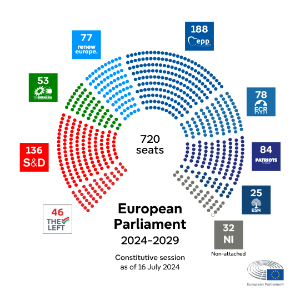
European Parliament’s seats distribution
It currently has eight political groups, each made up of various national parties. Diversity is reflected not only in national affiliations, but also in geographic representation, as each group must include at least a quarter of the member states. Twenty-three members are required to form a political group. Each group is responsible for its own internal organization by appointing a chairperson, a bureau and a secretariat.
However, there are some Members of the European Parliament (MEPs) who do not belong to any of the political groups and are part of the so-called “non-attached”. Although they enjoy the recognition on an individual level, they lack the organizational and strategic advantages offered by the political groups.
Politically, the “sin” in this parliamentary context lies in sticking to the national political line rather than a European vision. Effective representation in defense of the interests of “European citizenship” lies precisely in transcending national borders and embracing the construction of a common future for Europe.
Political groups for the Parliament’s 2024-2029 term
In each country, national political parties contest the elections and will subsequently be integrated (or not) into the political groups of the institution. Following the 2024 elections, the European Parliament’s 720 seats are distributed among several political groups. The European People’s Party (EPP) remains the largest faction, followed by the Progressive Alliance of Socialists and Democrats (S&D). The rest are Patriots for Europe, European Conservatives and Reformists, Renew Europe, Greens/European Free Alliance, The Left, Europe of Sovereign Nations and ‘non-attached Members’. Although the traditional centrist coalition of EPP, S&D, and Renew Europe still holds a majority, its margin has been reduced, highlighting the evolving political dynamics of the European Union.
🇪🇺 #EUElections2024: Updated seat projection for new European Parliament
Updated projection for the composition of the new Parliament based on final and provisional results in all 27 EU member states (as of 17.48 CET on 8 July).
🗳️Details: https://t.co/tl3clAzz33 pic.twitter.com/jU56xPZyuQ
— EP PressService (@EuroParlPress) July 9, 2024